
The Architecture of Emergence
Why Frontier Founders Need More Than a Pitch Deck
Ramona Tudorancea
5/14/20262 min read
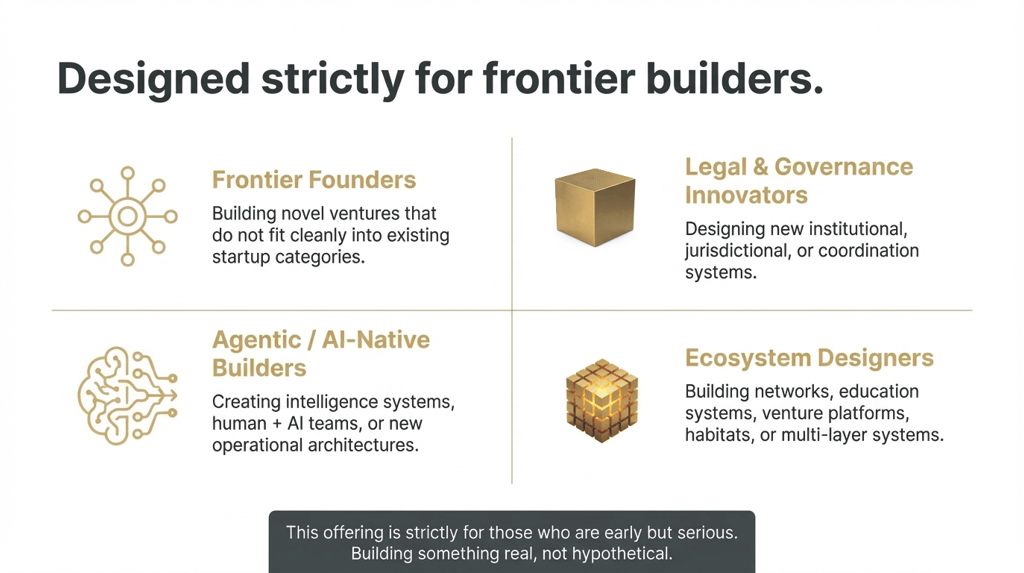
There is a quiet fracture running through modern civilization. We are living in a world where different layers of reality move at fundamentally different speeds: technology accelerates, culture struggles to interpret, and institutions lag behind. In this widening gap, systems break and coordination falters. For Frontier Founders, those operating in emerging technologies, Network States, and the agentic economy, this "Pacing Problem" isn't just a theoretical concept, but the primary reason their ventures are often deemed "illegible" by traditional capital.
At JupiterBlock Ventures, we’ve seen that most early-stage failure occurs before the first line of code is written or the first check is signed. Projects fail because the category is unclear, incentives conflict, or the legal structures are misaligned with the reality of the frontier. People abandon mid-way through, after burning out their cash reserves. To bridge this gap, we must move beyond traditional consulting. We need Venture Architecture.
Moving From Observer to Captain
In our Solarpunk Pirates Field Guide, we map the transformation an operator must undergo to be successful at the frontier:
Stage 1: The Observer – Consuming information and forming opinions without cost.
Stage 2: The Participant – Engaging in conversations but with low-stakes involvement.
Stage 3: The Builder – Creating under real-world constraints where failure becomes visible.
Stage 4: The Captain – Making irreversible decisions and taking responsibility for consequences under immense pressure.
Most people stay where intention feels sufficient. But the frontier rewards capability.
SignalCraft: The Foundational Frontier Skill
The first layer of capability for any Full Stack Operator is Perception, specifically Signalcraft. Signalcraft is the ability to sense edge-case opportunities and map systems before they fully form. It means detecting "weak signals" before they become obvious and distinguishing true signal from the noise of hype. Before you build, and before you act, you must learn to see what is actually emerging. At this stage, speed is irrelevant, and clarity is everything. Without the skill of Signalcraft, anything you build will be misaligned with the future it’s meant to inhabit.
The Venture Architecture Sprint: Designing for Coherence
Once a signal is identified, it requires a Structure, a container to hold the vision. This is where the Venture Architecture Sprint comes in. The Sprint is a high-intensity coordination and legibility process. It is not a startup accelerator or a workshop, but a discipline for translating frontier signals into structured ventures and inhabitable economic realities.
The Core Operating Sequence
We follow a strict sequence to move a venture from ambiguity to reality:
Signal: What is changing? Identify the hidden coordination problems.
Structure: What should exist? Translate the signal into stakeholder mapping, governance, and capital architecture.
Pathway: What happens next? Design the strategic sequencing and deployment roadmap.
Building a Future Worth Inhabiting
A business model is not just a revenue engine, in reality it is a micro-civilization design. For a venture to be truly "Solarpunk," it must pass three critical diagnostic tests:
The Agency Test: Does this increase people’s capacity to choose and act?
The Regeneration Test: Does this restore the substrate (trust, ecology, community) it depends on?
The Inhabitability Test: Would you actually want to live inside the world this creates if it succeeds?
Frontier Founders are not rebels against civilization, but scouts at its frontier. If you are ready to stop moving fast and breaking things, and start moving precisely and shifting things, the Venture Architecture Sprint is your entry point.
The future belongs to the weirdly competent.
Interested in bringing legibility to your frontier project? Learn more about our Venture Architecture Sprint or follow @rtudorancea for more insights into Legal Engineering and Solarpunk Futures.