
Designing Beyond the Deck
Why Venture Architecture Dictates Frontier Success
Ramona Tudorancea
5/19/20263 min read
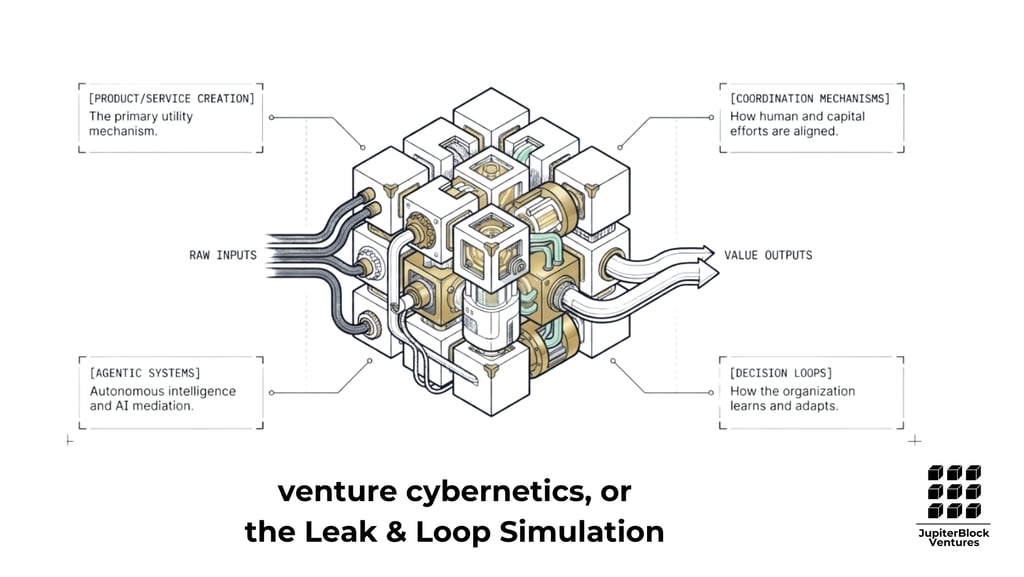
The traditional startup playbook is remarkably static. You draft a business model canvas, build a pitch deck, and map out a three-year financial projection built on linear assumptions. But if you are building in frontier environments, navigating the agentic economy, structuring Network States, deploying decentralized protocols, or anchoring deep-tech breakthroughs, then linear assumptions are an existential liability.
Frontier ventures do not operate as isolated product-delivery mechanisms. They exist as complex, dynamic, and evolving value-circulation systems. When early-stage systems fail, it is rarely due to poor code or slow marketing execution. In reality, they fail because they became operational before they became structurally coherent. Simply put, the ship left the shipyard before it was finished, and it didn’t hold against the storm of the current VUCA weather.
This is why we now treat venture design not as an exercise in static planning, but as an application of venture cybernetics. Central to this methodology inside our Venture Architecture Sprint is a distinctive protocol: The Leak & Loop Simulation Canvas.
Most traditional startup frameworks optimize for an aggressive sequence: fundraise, spend, acquire, grow, repeat. It is an architecture optimized for extraction, velocity, and dependency. It optimizes for Venture Capital metrics, aka to signal exponential growth. We introduce a fundamentally different ontology, which optimizes for circulation quality, system resilience, and regenerative compounding instead.
The Leak & Loop Simulation maps the venture across three deep structural layers:
Layer 1 — Primary Value Inputs: Mapping every raw flow the venture consumes to exist. This extends far beyond capital. We look at human attention, cognitive labor, community goodwill, data, trust, governance legitimacy, and ecological energy.
Layer 2 — The Core Transformation Engine: Analyzing the coordination mechanisms, agentic automation, and organizational intelligence that transform those raw inputs into structured value.
Layer 3 — Outbound Value Distribution: Tracing exactly who captures the upside, mapping the flow of value to founders, investors, users, workers, platforms, and local ecosystems.
By visualizing the venture as a living value network, founders stop asking "How do we sell more products?" and begin asking the architectural question: "What system wants to emerge here, and what structures make that emergence coherent?"
Structural Test 1: Systemic Leak Detection
Every architecture suffers from value dissipation. A leak occurs whenever value exits the system without structurally strengthening it. For a frontier founder, unrecognized leaks are the quiet precursors to systemic collapse. In this phase of the simulation, we map out and identify the hidden operational drains that weaken long-term resilience:
Platform Dependency Rents & Arbitrage: Where your infrastructure relies on web2 corporate stacks that extract margin or introduce arbitrary de-platforming risks.
Extractive Capital & Alignment Structures: Misaligned investor expectations that force unsustainable growth cycles, inducing talent churn or severe founder burnout.
Community and Data Depletion: Extracting value from your early user base or local ecosystem without recirculating equity, agency, or governance authority back to them.
When these flows are visualized, founders can clearly see where their creation is burning trust or creating systemic fragility.
Structural Test 2: Designing Reinforcing Loops
Once the leaks are isolated, the architecture must be designed to compound. This requires identifying and hardcoding reinforcing loops, flows that explicitly strengthen the system as they circulate. We want to design infrastructure where:
User success naturally drives local ecosystem referrals.
Community ownership directly optimizes long-term stakeholder retention.
Active contributors organically transition into system governors.
Agentic automation continuously frees human capital for higher-order strategic work.
When you architect self-sustaining loops, your venture stops feeling like an uphill battle of constant customer acquisition and begins to scale with the elegant, compounding efficiency of a natural ecosystem.
The Simulation Phase: Stress-Testing Sovereignty
A static map is only useful until the environment changes. We want to see what happens when we introduce shocks into the canvas model. This pressure test answers the ultimate structural questions: Which leaks become fatal under pressure? And which loops stabilize the system? By analyzing the nodes through the lens of resilience, we score what the venture truly owns and controls versus what is opaque or platform-mediated. In an emerging agentic economy, knowing exactly where your dependencies lie is the difference between systemic survival and sudden obsolescence.
Designing for Legibility and Longevity
Frontier founders regularly struggle with a core structural paradox: their revolutionary business models are fundamentally illegible to traditional capital and legacy legal systems.
The Leak & Loop Simulation is the first step to resolve this tension, because it transforms an ambiguous, complex vision into a visible, structurally coherent system of value flows, which can then be mapped out carefully and further stabilized through Venture Architecture. It shows patient capital and strategic stakeholders exactly how a venture coordinates people and manages risk.
We don't want to design startups to collect brief exit premiums while leaving behind an exhausted ecosystem. We want to design ventures as proto-institutions, durable architectures built to inhabit and shape the future economy.
Are you ready to stress-test your system before it goes live? The Leak & Loop Simulation is a core component of the Venture Architecture Sprint, our high-intensity coordination and legibility protocol designed explicitly for frontier founders. If you are ready to move past the static pitch deck and architect a resilient, self-sustaining venture model, reach out to explore our next Sprint cohort.